
Lead follow-up automation for Denver contractors: faster replies, same crew
You can't answer the phone from a roof. Here is what to automate when a call goes unanswered or a form comes in, what to leave to a person, and the texting rules to check first.
Research on online sales leads found that the first hour matters far more than most companies act like it does, and 23% of the companies audited never replied at all. A simple automation can text back a missed call, acknowledge a web form, log the lead and alert the right person within minutes. The machine buys you time. A person still does the estimate, the price and any promise about the work.
Turn Missed Calls Into Booked Jobs: an audio overview of this article.
AI-voiced audio overview of this article. If it differs from the text, the text is the reference.
Lead follow-up automation sounds like something for a company with a sales floor. It is more useful to a Denver contractor with six people and one phone. If you're on a roof in Park Hill or under a house in Lakewood when a homeowner calls, that call goes to voicemail, and the homeowner may simply try the next name on the list. You can't hire your way out of that for every hour of the day, but you can make sure nobody hears silence.
Why the first hour counts
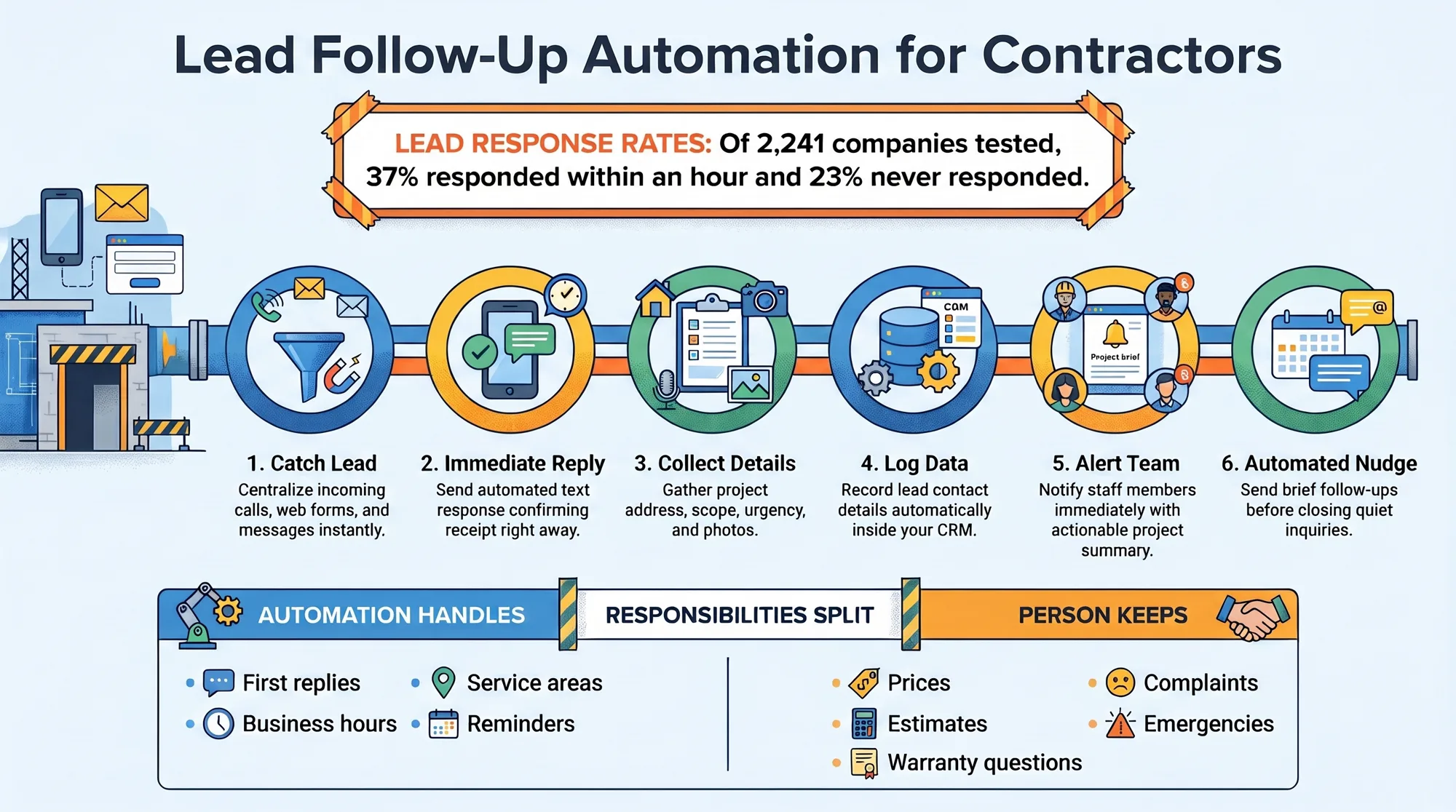
The study everyone quotes on this appeared in Harvard Business Review in 2011. Researchers sent test web leads to 2,241 US companies and timed the replies. Here's what they found:
- 37% responded within an hour.
- 16% responded within one to 24 hours.
- 24% took more than 24 hours.
- 23% never responded.
A second part of the research looked at about 1.25 million leads. Firms that tried to reach a lead within an hour were nearly seven times as likely to have a meaningful conversation with a decision maker as firms that waited one hour longer, and more than 60 times as likely as firms that waited a day or more.
Two honest caveats. The study is old, and it wasn't about contractors. Be wary of the sharper numbers you'll see on software sales pages, many of which trace back to nothing we could find. The direction is still sensible, though: someone with a leaking water heater or a storm-damaged fence wants an answer today, not a callback on Thursday.
There's a second reason if you buy leads through Google. Its help page for Local Services Ads lists average response time as part of profile quality and says plainly that "missed calls may negatively affect your responsiveness," which feeds into how your ads rank. Slow replies can cost you the lead in front of you and some of the next ones too.
What lead follow-up automation does
Strip away the marketing and it's a short chain of steps, most of which your phone system, website form and job-management software may already support. "AI" only needs to appear in one or two of them.
- Catch the lead. A missed call, a website form, a Google message or a referral email all land in one place, instead of four inboxes and a voicemail box.
- Reply right away. A short, honest message goes out: "Thanks for calling Front Range Plumbing. We're on a job and will call you back by 3. What do you need help with?" (The company name here is made up.)
- Collect the basics. Address, type of job, how urgent, and photos if they have them. This is where AI can help, by turning a rambling voicemail or text thread into a three-line summary.
- Log it. Name, number, source and summary go into your CRM (the customer list your business runs from) or job software, so nothing lives only on one person's phone.
- Alert a person. The right person gets a text with the summary and a tap-to-call number. If nobody has touched the lead by a time you set, it goes to someone else.
- Nudge, then stop. One or two follow-ups if the customer goes quiet, then the lead is marked closed. Nobody wants a fifth "just checking in."
If you want other low-risk places to start, we've also written up seven small-business automations that use software you probably already pay for.
Where to keep a human in the loop
The automation should be good at acknowledging and sorting, and it should be kept away from anything you could be held to. Our suggested line:
- Let it handle: the first reply, business hours, what areas you serve, collecting details, booking a callback slot, reminders.
- Keep for a person: prices and estimates, warranty and insurance claim questions, promised arrival times on a real job, complaints, and anything that sounds like an emergency. A customer who texts about a gas smell needs a real human and a clear instruction to call the gas company or 911, so write that message in advance.
- Don't pretend. If AI writes the replies, don't give it a fake name and a fake backstory. Say it's the office's automatic assistant and that a person will follow up. People forgive an automatic text. They don't forgive feeling tricked.
Ordinary lead replies are unlikely to be the kind of high-stakes decision Colorado's new AI law is aimed at, since it focuses on areas like employment, housing, lending and insurance. If you start using software to decide who gets financing, read that piece first.
The texting rules to check before you switch it on
Texting is where a helpful idea can turn into a legal or delivery problem. Four things to look at:
- Consent. Under the federal Telephone Consumer Protection Act, advertising or telemarketing sent by autodialer generally needs the person's prior express written consent. A short reply about the job someone just asked about is a different thing from a promotional blast, but the line deserves care. Add a clear consent line to your web form, keep first replies about the request itself, and don't move leads onto a coupon list without permission.
- Opt-outs. Senders have to honor "stop," "quit," "end," "revoke," "opt out," "cancel" and "unsubscribe," and current rules give you 10 business days to process a request. The FCC released another order on this on October 1, 2026, and is taking comment on a shorter window, so check where it stands. Your tool should stop automatically the moment one of those words comes in.
- Hours. Federal rules bar telephone solicitations to homes before 8 a.m. or after 9 p.m., the customer's local time. Follow-up nudges should respect that window even when they aren't strictly sales messages. It's simply good manners.
- Registration. US carriers expect business texts from ordinary 10-digit numbers to be registered, under a program called A2P 10DLC. Twilio, one of the big texting platforms, says anyone sending from an application over such a number must register, and that registered senders see less filtering. Ask your vendor who handles this, because an unregistered number can mean messages that quietly don't arrive.
A one-week setup checklist
Try this in order:
- Day 1: find the leaks. Pull last month's missed calls and web forms. How many got a reply, and how long did it take? That number is your baseline.
- Day 2: check what you own. Your phone system, website and job software may already offer missed-call texting or form alerts.
- Day 3: write the messages. A first reply, an after-hours reply, an emergency reply and one follow-up. Read them out loud. They should sound like your office.
- Day 4: set the routing. Who gets alerted, who is the backup, and how long before a lead moves to the backup?
- Day 5: test it. Call yourself from a cell phone, fill in your own form, and text "stop." Confirm each one does what it should, including getting logged.
- A month later: compare. Check reply times against your baseline, and read a sample of the conversations.
Common questions
What is speed to lead? It's how quickly a business responds to a new inquiry. In the research above, replying within the hour beat waiting one hour longer.
What is missed-call text back? An automatic text to someone whose call went unanswered, so they know you saw it and can say what they need.
Should AI give prices? No. Let it collect details and book a callback. A person should handle estimates.
The goal isn't a robot that sells. It's a crew that stays on the job while every caller gets a fast, honest answer and a real callback. At Lab 5280 we work with your team, not just for you, and we focus on automating how the business actually runs. If you'd like the broader picture, here's how we approach AI automation.
This article is general information, not legal advice. Before texting customers at scale, check your setup with a Colorado attorney.
Wondering where your leads are slipping?
Send us what happens today when a call goes unanswered. We'll walk through it with you and point out the simplest fix.
Talk to Lab 5280- The Short Life of Online Sales Leads — Harvard Business Review (Oldroyd, McElheran, Elkington, 2011)
- Are you letting online leads go cold? — SmartCompany (summary of the study's figures)
- About ad rankings — Google Local Services Ads Help
- 47 CFR 64.1200, Delivery restrictions — Legal Information Institute, Cornell Law School
- FCC Revamps Rules on Consent to Calls and Texts Under the TCPA — Latham & Watkins
- FCC Adopts Final Order and Further Notice on TCPA Consent Revocation — Inside Global Tech (Covington)
- A2P 10DLC — Twilio Docs